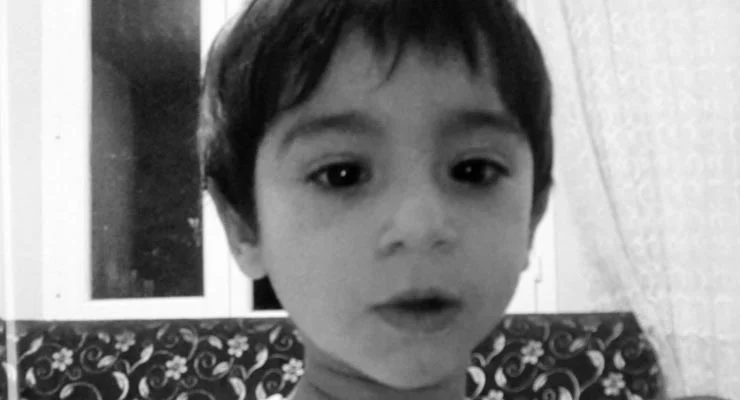
On 11 October 2015, three-and-a-half-year-old Tevriz Dora was shot in the head while being held by his mother outside a neighbour’s house near their home in Adana. He was taken to Çukurova Dr. Aşkım Tüfekçi State Hospital, where he died later that day. According to the autopsy report, he died from a gunshot wound to the head that caused skull fractures, cerebral hemorrhage and damage to brain tissue.
According to a crime scene inspection report prepared by the Adana Chief Public Prosecutor’s Office on 12 October 2015, the scene could not be examined that day because demonstrations were ongoing in the area, Mithatpaşa Avenue was crowded, and there was a risk of further unrest that could endanger those present. On 16 October 2015, the public prosecutor inspected the scene in the presence of Tevriz Dora’s parents and their lawyers. In a letter dated 9 November 2015, the Adana Police Forensic Laboratory reported that there were no bullet holes in the child’s clothing.
On 12 October 2015, the prosecutor ordered an examination of MOBESE footage and footage from businesses overlooking the scene. The prosecutor also requested camera recordings from official, plain-clothes and armoured police vehicles operating in the area at the time of the incident. These steps were intended to identify the person responsible. Tevriz Dora’s father, Azem Dora, had said that his son had been shot by police.
A report dated 26 October 2015 examined recordings provided by the Adana Police Department, including footage from riot police vehicles and MOBESE cameras. None of the footage showed how Tevriz Dora had been shot. A further report dated 2 November 2015 found no security cameras at homes or businesses in or around the scene.
Police officer M.S. prepared a report on 11 October 2015 concerning the camera system of the armoured vehicle with code number 2474 and registration plate 01 A 0533, which had been on duty that day. According to the report, the camera switched off by itself at 00.45 and could not be restarted. A letter dated 12 October 2015 also reported that the camera system of the Shortland armoured vehicle with code number 2474 was not working. The vehicle was taken to the maintenance unit, and the device was sent for servicing.
On 13 October 2015, the Chief Public Prosecutor’s Office requested a restriction on access to the investigation file. The Adana 3rd Criminal Peace Judgeship granted the request. The family’s lawyer objected, but the objection was rejected. On 16 October 2015, the prosecutor took statements from Tevriz Dora’s parents. His mother, Kamile Dora, said that her son had been in her arms when he was shot.
On 2 November 2015, the complainants’ lawyers submitted material concerning the incident to the prosecutor’s office. This included press footage, photographs showing bloodstains and the silhouettes of armed individuals, and eight empty cartridge cases said to have been collected from the scene and surrounding area. The Adana Police Forensic Laboratory established that the eight cartridge cases had been fired from two different weapons. A comparison with cartridge cases registered in the BALİSTİKA system found no match based on the available markings.
On 4 March 2016, the prosecutor ordered statements to be taken from the police officers who had been on duty on the day of the incident. The CD and photographs submitted by counsel for the complainants were also to be examined, and the cartridge cases recovered from the scene were to be compared with the handguns and long-barrelled firearms carried by the officers on duty that day. The officers said that water cannons and tear gas had been used against demonstrators in the area. They said that they had remained on the main avenue and had not entered the side streets, but had heard gunfire coming from them. One of the armoured vehicles also suffered a punctured tyre, after which warning shots were fired into the air.
An expert report issued by the Adana Police Forensic Laboratory on 18 April 2016 established that one of the eight cartridge cases examined had been fired from a Beretta semi-automatic pistol and another from an MP-5 submachine gun. The remaining six had not been fired from any of the police weapons submitted for examination. In a letter dated 20 April 2016, the Adana Police Department identified the Beretta pistol bearing serial number X07676A-01 as the service weapon issued to Deputy Commissioner Özben Güvenç of the Anti-Terror Branch. The MP-5 had been issued to the Anti-Terror team assigned to vehicle 2474.
Following these findings, Özben Güvenç gave a statement as a suspect on 19 August 2016. He said that he had been on duty in the Denizli and Mithatpaşa neighbourhoods on the day of the incident and had deployed teams to intervene in the demonstrations. He denied going to 58308 Street, where the incident occurred, or to the entrance of the street.
Güvenç said that he had been in the Shortland armoured vehicle with code number 2474. The vehicle carried MP-5 and Kalashnikov-type firearms, and any member of the team could use the MP-5. Güvenç acknowledged that one of the cartridge cases had been fired from his pistol and another from the team’s MP-5. However, he argued that the cartridge cases might have been collected around 500 metres before or beyond the scene and could therefore not be linked to the child’s death. He denied firing towards the street where Tevriz Dora was shot, either from within the street or from the avenue overlooking it, and rejected the allegation against him.
On 15 November 2016, the Chief Public Prosecutor’s Office sought authorisation from the Adana Governor’s Office to investigate the police officers suspected in connection with the incident. The Governor’s Office issued a preliminary examination report on 9 January 2017. The report stated that neither the firearm that caused the child’s death nor the person who used it could be identified. It noted that police officers Ali Üstüner and Sedat Taş had acknowledged using their firearms during the incident and that one of the cartridge cases had been fired from Özben Güvenç’s service pistol.
Nevertheless, the Governor’s Office refused authorisation for an investigation. It found no information, document or report establishing that Tevriz Dora had been killed by a bullet fired from a weapon used by Ali Üstüner, Sedat Taş or Özben Güvenç. Counsel for the complainants objected. On 18 May 2017, the 3rd Administrative Chamber of the Konya Regional Administrative Court overturned the refusal. It held that the responsibility of individual police officers could only be determined through a criminal investigation and that, given the death involved, an investigation should be authorised.
Özben Güvenç was interrogated again on 15 June 2017. Ali Üstüner also gave a statement that day. Üstüner said that he had fired three or four warning shots into the air with an MP-5 while intervening against demonstrators on Mithatpaşa Avenue in the Denizli neighbourhood. He had fired from the turret of an armoured vehicle. However, he denied entering the street where Tevriz Dora was shot. According to Üstüner, the cartridge cases later collected from the scene and submitted to the investigation file might have come from the warning shots he had fired.
In his statement on 20 June 2017, Sedat Taş said that he had been deployed to the area as part of a reinforcement team. During the intervention on Mithatpaşa Avenue, gunfire punctured a tyre of the armoured vehicle in which he was travelling. The teams then fired warning shots into the air. Taş said that he had fired one shot into the air with an MP-5. However, he denied taking part in any intervention in or around the street where Tevriz Dora was shot. He said that he had learned of the child’s death only after the events and maintained that his shot had not caused the death.
On 7 November 2017, the prosecutor issued a decision of non-prosecution. Counsel for the complainants objected, but the Adana 2nd Criminal Peace Judgeship rejected the objection on 13 February 2018. On 19 February 2018, the case was placed under permanent investigation because the perpetrator or perpetrators had not been identified. Azem Dora and Kamile Dora lodged an individual application with the Constitutional Court through their lawyers on 23 March 2018.
The Constitutional Court found a violation of the right to life and ordered a new investigation by the Adana Chief Public Prosecutor’s Office. Following the Constitutional Court’s decision, the restriction on access to the investigation file was lifted. On 26 January 2022, the Adana 5th Criminal Peace Judgeship set aside the decision of non-prosecution.
The Adana Chief Public Prosecutor’s Office then brought criminal proceedings against Ali Üstüner, Özben Güvenç and Sedat Taş on charges of killing and causing injury with eventual intent (dolus eventualis). The case was brought before the Adana 4th Assize Court.
At the first hearing on 30 December 2022, Tevriz Dora’s parents, their lawyers and the defendants were present. Counsel for the complainants requested that the defendants be remanded in custody pending trial, but the court rejected the request. It ordered the production of Ali Üstüner and Özben Güvenç before the court.
At the second hearing on 16 May 2023, the court heard the defendants and witnesses. Sedat Taş said that he had fired into the air approximately 100–150 metres from the street where Tevriz Dora had been. Ali Üstüner said that he had fired three or four shots into the air three or four streets away from the scene. Özben Güvenç maintained that he had not fired his service pistol that day.
Witness Ö.G. said that she had been sitting outside the house with Tevriz Dora’s mother, Kamile Dora, and neighbours when she saw the lights of an armoured police vehicle approaching. According to Ö.G., shots were then fired towards them. They later realised that Tevriz Dora had been hit. Witness M.E.G. similarly described seeing the headlights of a police vehicle. He then heard a gunshot followed by a scream and realised that Tevriz had been shot.
Police witness Ş.T. said that he had not seen any shots being fired from police vehicles that day. S.Ç. had heard gunfire but did not see whether it came from the police or the demonstrators.
At the same hearing, the court ordered that police officers who had been on duty that day but had not yet testified be heard. It also ordered further inquiries into MOBESE footage from the scene and whether the TOMA water-cannon vehicles and other police vehicles had camera systems. The court ordered that police radio communications be examined by an expert who was not a member of the police and requested cell-site data relating to witness M.E.G. at the time of the incident.
At the hearing on 14 November 2023, it emerged that the camera footage sent to the court was either incorrect or incomplete. The court instructed the Adana Police Department to provide all footage relating to the incident and ordered a transcript of the police radio communications.
At the hearing on 15 October 2024, the court decided to hear the witnesses in person and commissioned an expert report. The expert was asked to arrange the video footage and any available audio recordings in chronological order and determine whether the recordings had been altered. The court specified that the expert could not be a current or former employee of the Police Department.
At the hearing on 20 February 2025, the expert report had still not been submitted. The court also heard police officer A.K. as a witness.
By the hearing on 16 September 2025, the expert report had been added to the case file. Counsel for the complainants challenged the way it had been prepared. They requested a fresh examination of the security camera recordings held as evidence, the production of police radio communications from the day of the incident, and a new expert report. Counsel also requested further information from the municipality and TEDAŞ concerning lighting at the scene. They asked for S.E., whose name had been provided by Vodafone, to be heard as a witness and for the emergency-call records from that day to be obtained. The court granted some of these requests.
At the hearing on 21 May 2026, the court decided that, unless there were further requests for additional evidence, the prosecutor submit an opinion on the merits. The next hearing was scheduled for 15 October 2026 at 09.45.