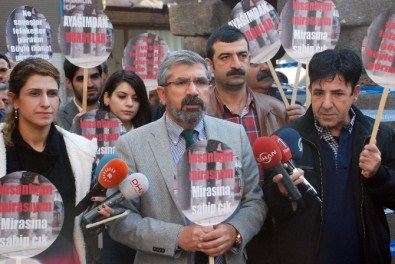
On 28 November 2015, Tahir Elçi, President of the Diyarbakır Bar Association, was fatally shot in the head during an armed clash in the Sur district of Diyarbakır. At the time, he was making a press statement in front of the Four-Legged Minaret to draw attention to the damage that armed clashes in the city were causing to its cultural heritage.
The clash began shortly before Elçi was shot, when two PKK members exchanged fire with police on Gazi Street. Police officers Ahmet Çiftaslan and Cengiz Erdur were killed in the exchange. The two PKK members then entered Yenikapı Street, where the press statement was taking place, bringing the clash into the area.
The prosecutor in charge of the investigation into Tahir Elçi’s death changed several times. A crime scene examination was not conducted until 17 March 2016, almost five months after his death. The bullet that killed Elçi was never found. Security cameras on the street did not capture the moment he was shot, while police camera footage was found to contain a 13-second interruption.
In an expert report prepared for the Diyarbakır Chief Public Prosecutor’s Office on 19 March 2016, forensic medicine and ballistics experts found that it was not possible to determine which firearm had fired the fatal shot, the angle of the shot, or Elçi’s body position when he was shot. On 20 June 2016, the Council of Forensic Medicine also found that the direction of fire could not be determined medically.
At the request of the Diyarbakır Bar Association, Forensic Architecture at Goldsmiths, University of London prepared a technical report examining visual, audio and documentary material from the incident. The report found that three police officers at the scene had a direct line of fire towards Elçi and had fired their weapons more than once. One of the three was the only officer who fired while he had a clear and unobstructed line of fire towards Elçi.
The two PKK members who fled into Yenikapı Street after killing the two police officers did not appear to have fired the fatal shot. The report also found no audio evidence that a long-barrelled firearm had been fired from a distance, contrary to statements by some police officers.
The Diyarbakır Bar Association submitted the report to the Diyarbakır Chief Public Prosecutor’s Office on 14 December 2018. On 17 March 2019, a report prepared by forensic medicine expert Prof. Dr. Ümit Biçer was also submitted to the prosecutor’s office, with a request to expand the investigation. The Chief Public Prosecutor’s Office then asked the Council of Forensic Medicine for a new assessment. In its report of 18 March 2019, the Council found no grounds to revise or add to its 2016 report.
An indictment was issued on 20 March 2020, almost five years after Tahir Elçi was killed. It named as suspects the three police officers identified in the Forensic Architecture report and one of the two PKK members who had entered Yenikapı Street during the incident. The other PKK member was reported to have been killed during clashes that took place under the curfews.
The three police officers were charged with causing death by conscious negligence, while the PKK member was charged with causing death with eventual intent (dolus eventualis). The finding that a bullet fired from one of the police officers’ weapons had a higher probability of hitting Elçi was not taken into account in the indictment.
At a preliminary hearing on 27 March 2020, the Diyarbakır 10th Assize Court asked the Diyarbakır Governor’s Office and the Chief Public Prosecutor’s Office whether holding the trial in Diyarbakır would pose a risk to public security.
The first hearing was held on 21 October 2020. The court rejected a request by counsel for the complainants to consider their applications to join the proceedings before hearing the defendants’ statements. Counsel then sought the recusal of the trial bench, arguing that it was neither independent nor impartial. The case file was sent to a higher court for the recusal request to be considered.
At the second hearing on 3 March 2021, the court reversed its earlier interim ruling and considered the applications to join the proceedings before hearing the defendants’ statements. After the defendants presented their defence, the court rejected requests to remand them in custody. It imposed travel bans, ordered that they attend subsequent hearings by video link through SEGBİS, and decided to hear witnesses.
At the hearing on 14 July 2021, five witnesses were heard, two of them anonymously. The anonymous witnesses known as “Lojman 2019” and “i61” changed their earlier statements and said that they had not seen the incident. One witness said that the prosecutor had deceived them. Another said that they had been in prison on the date of the incident, while another had been outside Diyarbakır.
The court ordered TÜBİTAK to examine camera recordings that had been deleted. It also ordered that the digital records be provided to the intervening party for examination abroad and requested the names of all police officers who had been on duty on the day of the incident, as well as the report prepared by the Ministry of the Interior’s Civil Inspection Board. The court decided to consider the request for an on-site inspection at a later stage.
At the hearing on 12 January 2022, a request was made for a criminal complaint to be filed against former prosecutor Kenan Karaca after witnesses heard at the previous hearing said that they had given their statements under torture. The court rejected the request. An examination of the hard drive from a security camera at Mardin Kebapevi, which overlooked the scene, found that it was completely empty. The court also rejected requests to remand the defendants in custody.
At the hearing on 15 June 2022, a 59-page administrative inquiry report was added to the case file. The report had been prepared by two chief civil inspectors and a chief police inspector appointed by the Ministry of the Interior and the General Directorate of Security and submitted to the Civil Inspection Board on 23 June 2017. It stated that some matters had not been examined because the Diyarbakır Chief Public Prosecutor’s Office had not shared certain information and documents from the criminal investigation with the inspectors conducting the administrative inquiry. The report also revealed that the Intelligence Branch had intercepted the telephone communications of PKK member Mahsum Gürkan for two years before Elçi was killed.
TÜBİTAK also examined camera recordings from the PTT Balıkçılarbaşı Central Directorate and Mardin Kebapevi. The hard-drive image initially provided for examination was empty, while the images sent by the court a second time were corrupted. The court therefore asked the Council of Forensic Medicine to determine whether the 12 seconds of missing footage had been deleted, whether the footage had been edited, and what had caused the interruption.
The court rejected requests by counsel for the intervening parties to hear intelligence officers who had been at the scene and to require the police defendants to appear physically in court rather than through SEGBİS. It also decided to hear Ahmet Davutoğlu, who had been Prime Minister at the time of the incident, as a witness.
On 19 September 2022, the court reversed that decision, finding that hearing Ahmet Davutoğlu would add no new information to the case. At the hearing on 23 November 2022, counsel for the intervening parties requested further evidence to be gathered. The court decided to await TÜBİTAK’s response concerning the Mardin Kebapevi camera recordings and continued the travel bans imposed on the defendants.
At the hearing on 5 July 2023, counsel again requested that Ahmet Davutoğlu be heard as a witness, but the court rejected the request. It decided to await TÜBİTAK’s response and the completion of the other outstanding evidentiary matters.
At the hearing on 29 November 2023, the court rejected all requests for further evidence and sent the case file to the public prosecutor to prepare the opinion on the merits. At the hearing on 6 March 2024, counsel for the intervening parties renewed their requests for further evidence to be gathered, but the court again rejected them.
At the final hearing on 12 June 2024, the Diyarbakır 10th Assize Court acquitted all of the police defendants.
Following the appeal against the acquittal of the police officers, the 10th Criminal Chamber of the Diyarbakır Regional Court of Appeal rejected the appeal on 4 January 2025, finding the first-instance court’s decision to be lawful. As there was no further right of appeal to the Court of Cassation in the case, the acquittal became final.